

High-volume recruitment is a monumental operational challenge in South Africa. Whether hiring for retail, logistics, security, or entry-level corporate positions, HR managers and recruitment agencies are routinely inundated with thousands of applications for a handful of vacancies.
Conventionally, the hiring pipeline follows a familiar trajectory: post a listing, sift through a mountain of CVs, shortlist candidates based on qualifications, and invite them to interview.
However, business leaders are increasingly discovering a critical, invisible flaw in this traditional workflow. While a CV can validate skills and experience, it completely fails to measure a candidate’s core ethical baseline. To protect their funnels, top firms are turning to screening tools like the Workplace Ethics Scale before premium management hours are routinely squandered interviewing candidates who look flawless on paper but are fundamentally unsuitable due to a disposition toward Counter-Productive Workplace Behaviour (CWB).
The Devastating Impact of Counter-Productive Behaviour
Counter-Productive Workplace Behaviour encompasses any intentional, destructive action by an employee that harms an organisation or its stakeholders. This ranges from high-risk offences like fraud, theft, bribery, corruption, and leaking confidential data to operational disruptors like deliberate absenteeism, workplace aggression, rule-breaking, and presenteeism.
When a high-risk candidate slips past early recruitment defences, the fallout is severe. Beyond the immediate financial losses and legal headaches, a single “bad apple” can corrode team morale, shatter internal trust, and severely damage a brand’s reputation.
For large enterprises, relying purely on late-stage vetting or post-interview background checks to catch these behavioural flaws is an expensive gamble. By the time a candidate’s risk profile is uncovered at the final hurdle, or worse, after they have been onboarded, thousands of Rands in administrative overhead and invaluable management time have already been lost. Proactively shifting this approach directly impacts the ROI of ethical hiring, showing how investing in the right people pays massive dividends in fraud prevention.

Rethinking the Funnel with Workplace Ethics Scale: Integrity Testing at the Gateway
To eliminate this waste and protect the bottom line, forward-thinking organisations are re-engineering their recruitment funnels by placing a scientific gatekeeper at the very first touchpoint.
This is where South African workforce risk specialist EmployInsight is shifting the paradigm with its Workplace Ethics Scale (WES). Developed by Dr Richard Hunter under the auspices of the University of Stellenbosch, the WES is a highly validated psychometric instrument provisionally registered with the Health Professions Council of South Africa (HPCSA).
Instead of treating integrity validation as an afterthought, the Workplace Ethics Scale flips the process. Understanding what an integrity test is and how it operates allows companies to filter out high-risk applicants before an interview is even scheduled.
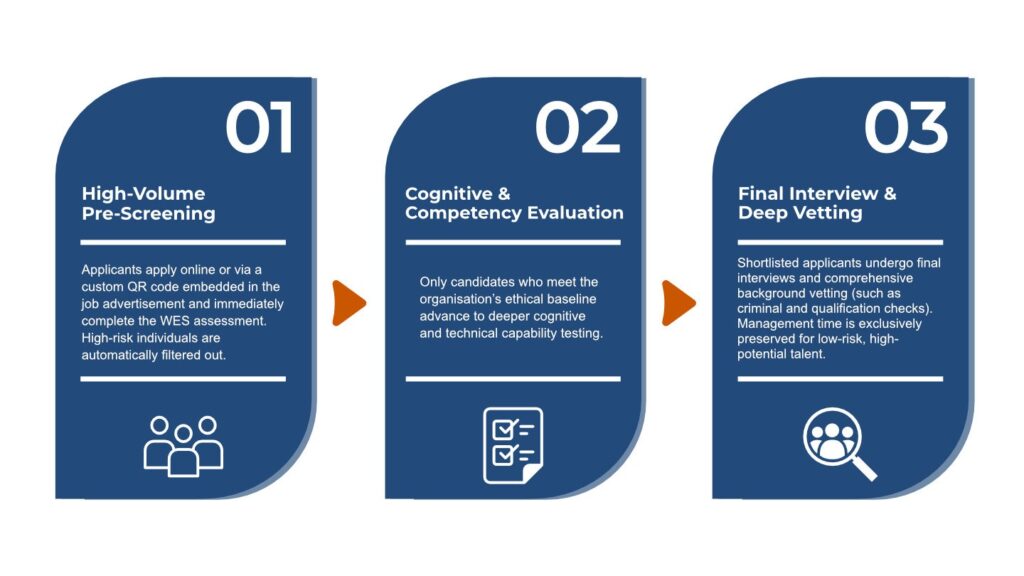
By integrating WES into a high-volume intake, the hiring process evolves into an optimised, multi-tier funnel:
- Phase 1: High-Volume Pre-Screening: Applicants apply online or via a custom QR code embedded in the job advertisement and immediately complete the Workplace Ethics Scale assessment. High-risk individuals are automatically filtered out.
- Phase 2: Cognitive & Competency Evaluation: Only candidates who meet the organisation’s ethical baseline advance to deeper cognitive and technical capability testing.
- Phase 3: Final Interview & Deep Vetting: Shortlisted applicants undergo final interviews and comprehensive background vetting (such as criminal and qualification checks). Management time is exclusively preserved for low-risk, high-potential talent.
Scalable, Affordable, and Built for South African Realities
A major barrier to early-stage testing has traditionally been cost and accessibility. EmployInsight has solved this by engineering the Workplace Ethics Scale specifically for high-volume, cost-sensitive environments. This is particularly vital in specialised sectors, as seen in the clear benefits of psychometric testing in the security environment and optimisation trends regarding psychometric testing in the logistics industry.
At just R120.00 per assessment, the tool allows corporate enterprises to screen thousands of applicants simultaneously without straining HR budgets. The assessment is remarkably lightweight: it consists of 46 straightforward statements written at an accessible Grade 8 English reading level. Candidates can complete the test in under 20 minutes on any smartphone, tablet, or PC, making it highly accessible to a broad demographic.
Crucially, the WES features an advanced, built-in Lie Scale (Self-Deception monitor). This sophisticated mechanism actively identifies manipulative or fraudulent response patterns, ensuring that candidates cannot simply “fake” their way through the questions to give socially desirable answers.
A First Line of Defence, Not a Total Replacement
EmployInsight explicitly highlights that the WES is designed to complement, rather than replace, subsequent hiring steps. It serves as a rapid, affordable first line of defence for efficiently thinning massive applicant pools.
Once the WES handles the heavy lifting of removing behavioural risks early in the pipeline, organisations can then deploy their premium vetting resources, such as deeper cognitive tests, competency assessments, and biometric background checks, solely on the final, verified contenders.

Turning Risk Mitigation into Operational Excellence
The business case for integrating early-stage integrity testing is clear. By shifting from reactive damage control to proactive risk mitigation, organisations drastically compress their recruitment cycles from weeks to hours. Comprehensive candidate risk profiles, categorised into clear High, Moderate, or Low Risk benchmarks, are delivered within 12 to 24 hours of test completion.
The long-term operational benefits are substantial: lower staff turnover, a dramatic reduction in future CCMA disputes or disciplinary hearings, and the security of knowing that your workforce is anchored in integrity from day one.
For corporate leaders and HR directors looking to modernise their recruitment strategy, the solution lies in screening for character before capability.
To find out how to integrate the Workplace Ethics Scale into your next recruitment period, contact EmployInsight for a comprehensive Needs Assessment.